
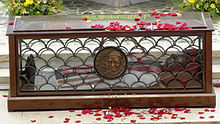
The body of Blessed Cyprian Michael Iwene Tansi on display during his silver jubilee celebration at Holy Family Catholic Church, Festac Town, Lagos.
While serving in his last parish, in his own hometown of Aguleri from 1949-1950, Michael began to become attracted to the monastic life. At that time, there were no monasteries established in Nigeria, and the Bishop was interested in the idea of sending some candidates to a monastery in Europe who would become monks in Europe and later return to Nigeria to start up the first Nigerian monastery. Michael and others were selected for this project.]
1950 was a jubilee year in the church, and Michael was first sent to Rome to make the pilgrimage to the four major basilicas. He was then sent to Mount St. Bernard in England, to join the Trappist monks there. He arrived on 8 June 1950.]
At the monastery, he joined the novitiate and took his vows, taking the name Cyprian after the Roman martyr. Fr. Cyprian worked in the refectory and bookbindery, and in the vegetable gardens and orchard. He used to say, “If you are going to be a Christian at all, you might as well live entirely for God”. Father Anselm Stark, who knew Fr Cyprian, recalled: “As a person he was very ordinary, very humble, obviously a great man of deep prayer and dedication.”
Bl. Cyprian was sensitive to criticism, and his novice master was very hard on the new monks, and could always find things that were wrong with what he had done. This caused him much stress, and it was during this trying time that he understood that he had made some mistakes in Nigeria with the hard discipline and expectations he had placed on those under him. Despite fears of being treated with racial prejudice, he was fully accepted by the other monks, with the exception perhaps of one South African monk, who seemed to look for things to find wrong in his work.[11] The English winter was also hard on him.
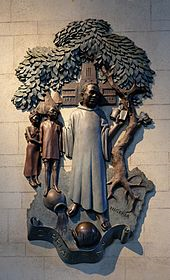
Sculpture by Leicester Thomas on the wall in Mount St Bernard Abbey
He was commissioned to establish a monastery not in Nigeria, but in neighboring Cameroon, but ill health changed those plans. He did not feel that the Nigeria independence movement had been properly done. His health deteriorated, but he accepted death with no complaint. Before he died, he went to Leicester Royal Infirmary, and, when he was examined, the doctor came out of the examination and spoke with monastery priest Fr. James, saying: “Can you help me please, Father? This man must be in terrific pain, but he will only admit that he has ‘a little pain.'” He died the same day, as a result of arteriosclerosis and a ruptured aneurysm. The date of his death was 20 January 1964.[5]
His body was buried at the monastery in England, but was later interred at the Cathedral Basilica of the Most Holy Trinity, Onitsha, Nigeria.[8]